
Prepaid vs COD Shipping: Pros, Cons and What to Choose (2026)
27 August 2026 · 11 min read · by Courier Uncle team
Cash on Delivery gets you the order. Whether it gets you the money is a different question entirely.
If you’re selling on Meesho, running a Shopify store, or fulfilling Amazon orders, you’ve probably felt this tension already — COD brings in volume, especially from buyers who don’t fully trust you yet. But it’s also, quietly, the more expensive way to run your business, and most sellers don’t realise by how much until they sit down and actually calculate it.
This isn’t a “COD bad, prepaid good” argument. It’s a practical way to decide the right mix for your category, your buyer’s city, and the order value — whether you’re shipping out of Mumbai, Bangalore, Delhi NCR, Noida, Chennai, or anywhere else in the country.
COD and prepaid, in one line each
Cash on Delivery means the buyer pays when the package physically arrives — your courier collects the payment and remits it to you after their settlement cycle. Prepaid means the buyer pays upfront at checkout, through UPI, card, or net banking, and the money reaches you almost immediately.
Simple enough on paper. The real difference shows up in what each one actually costs you — and that’s rarely just the payment method itself.
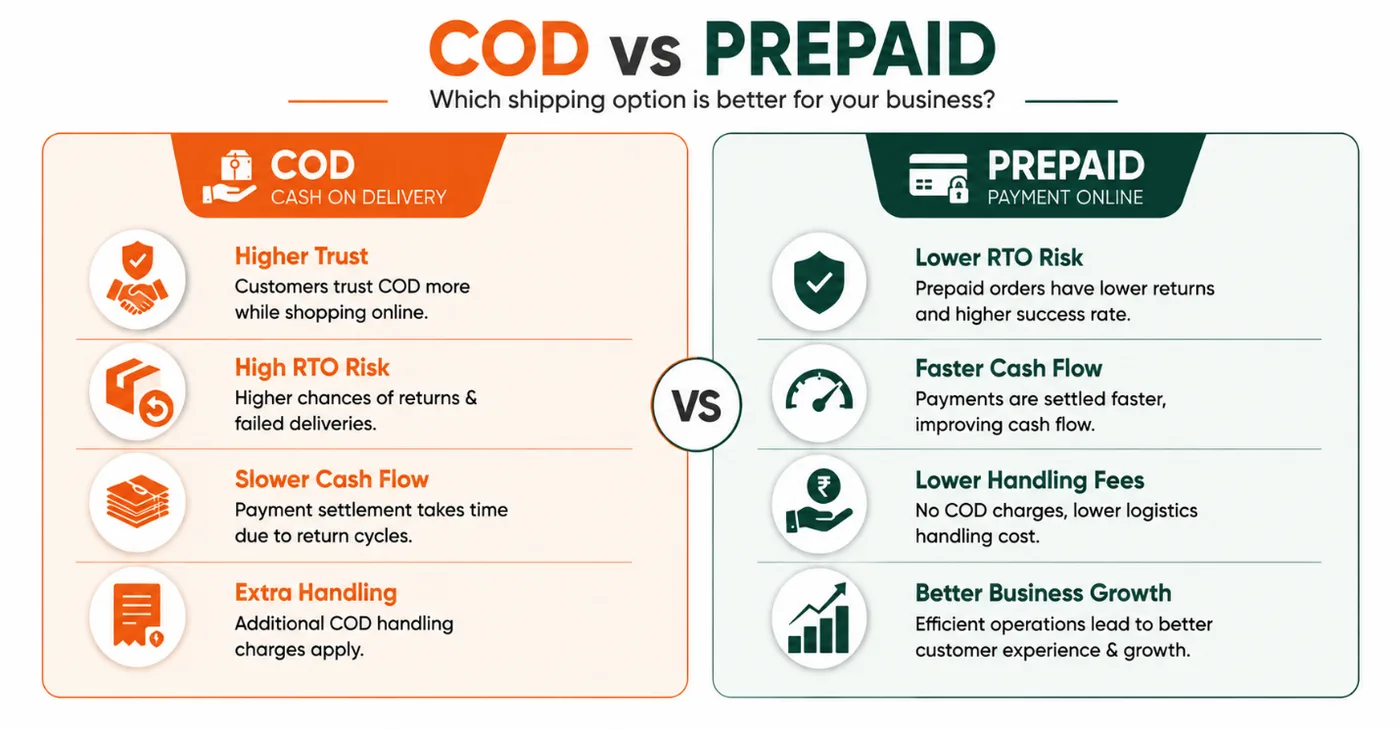
The real pros and cons of COD
Why COD still works
COD isn’t popular by accident. It removes the biggest barrier for a first-time buyer — the fear of paying for something from a brand they’ve never bought from before. This matters even more in Tier 2 and Tier 3 cities, where digital payment habits are still catching up. It also drives genuine impulse buying — no payment friction at checkout means more people actually complete the purchase. COD still makes up a significant majority of e-commerce orders in India, and ignoring it isn’t realistic for most sellers.
What COD actually costs you (beyond the obvious)
This is where most sellers underestimate the real number:
- COD handling fee — either a flat charge per shipment or a percentage of order value, charged by your courier
- Higher RTO — 15–25% is a common range for COD-heavy categories, and every RTO means paying for both forward and return freight
- Delayed cash flow — you wait for the courier’s remittance cycle before that money is actually yours to use
- GST on COD handling charges — an extra, easy-to-miss outflow that prepaid transactions simply don’t carry
There’s one more thing that rarely gets mentioned: COD isn’t universally available. Many couriers cap COD collection at a maximum order value — commonly somewhere around ₹40,000–50,000 — and some remote or rural pincodes don’t support COD at all, only prepaid. If you’re assuming every order qualifies for COD by default, it’s worth checking this per courier, because the limits aren’t the same everywhere. Similar hidden charges show up on the shipping side too — worth understanding in full if you haven’t already.
The real pros and cons of prepaid
Why prepaid is gaining ground
When a buyer pays upfront, they’ve made a commitment — and that single behavioural shift is why prepaid RTO rates run so much lower than COD, often under 5–8%. Money also reaches you almost instantly, which means healthier working capital and less time spent reconciling remittances. Operationally, it’s simpler too — no COD disputes, no waiting on courier settlement reports.
Where prepaid falls short
It’s not free of downsides. Prepaid can alienate buyers who aren’t yet comfortable paying online, especially first-time shoppers or those in smaller towns. Push it too hard, too early, with a brand that hasn’t earned trust yet, and you’ll simply lose the sale to cart abandonment. And if your checkout has any UPI friction — extra steps, slow loading, confusing screens — a chunk of buyers will just default back to COD out of frustration, not preference.
COD vs prepaid — side by side
| Factor | COD | Prepaid |
|---|---|---|
| RTO rate | 15–25% typical for COD-heavy categories | Usually under 5–8% |
| Cash flow | Delayed — settles after courier remittance cycle | Near-instant on successful order |
| Handling fees | COD fee (flat or % of order value) + GST on it | Payment gateway fee only, usually lower overall |
| Buyer trust needed | Low — works even for first-time, unfamiliar brands | Higher — buyer needs some confidence in your brand |
| Best-fit category | Fashion, accessories, home décor, impulse buys | Electronics, customised products, high-value items |
| Best-fit city tier | Tier 2/3, rural pincodes | Metro, Tier 1 — Mumbai, Bangalore, Delhi NCR, Chennai |
| Best-fit order value | Low to mid AOV | Mid to high AOV |
Where COD actually breaks — coverage and order value limits
This part rarely gets discussed, but it directly affects how many of your orders can even be COD in the first place.
Every courier sets its own COD ceiling — some cap it lower than others, and if your order value crosses that line, COD simply isn’t an option for that shipment through that partner. On top of that, certain rural and far-flung pincodes aren’t COD-serviceable at all, no matter which courier you use — only prepaid gets through.
This is one more reason sellers compare multiple courier partners instead of relying on one. If your default courier caps COD at a value your average order exceeds, or doesn’t service a pincode you’re shipping to, you could be losing COD-eligible orders unnecessarily — not because the buyer wouldn’t have paid COD, but because your one courier couldn’t offer it there. (The single-courier-vs-aggregator trade-off has its own guide.)
The middle path: partial COD
Full COD or full prepaid isn’t the only choice anymore. A growing number of Meesho and D2C sellers are using partial COD — a small token amount, often ₹49–100 or 10–20% of the order value, is paid upfront, and the rest is collected on delivery.
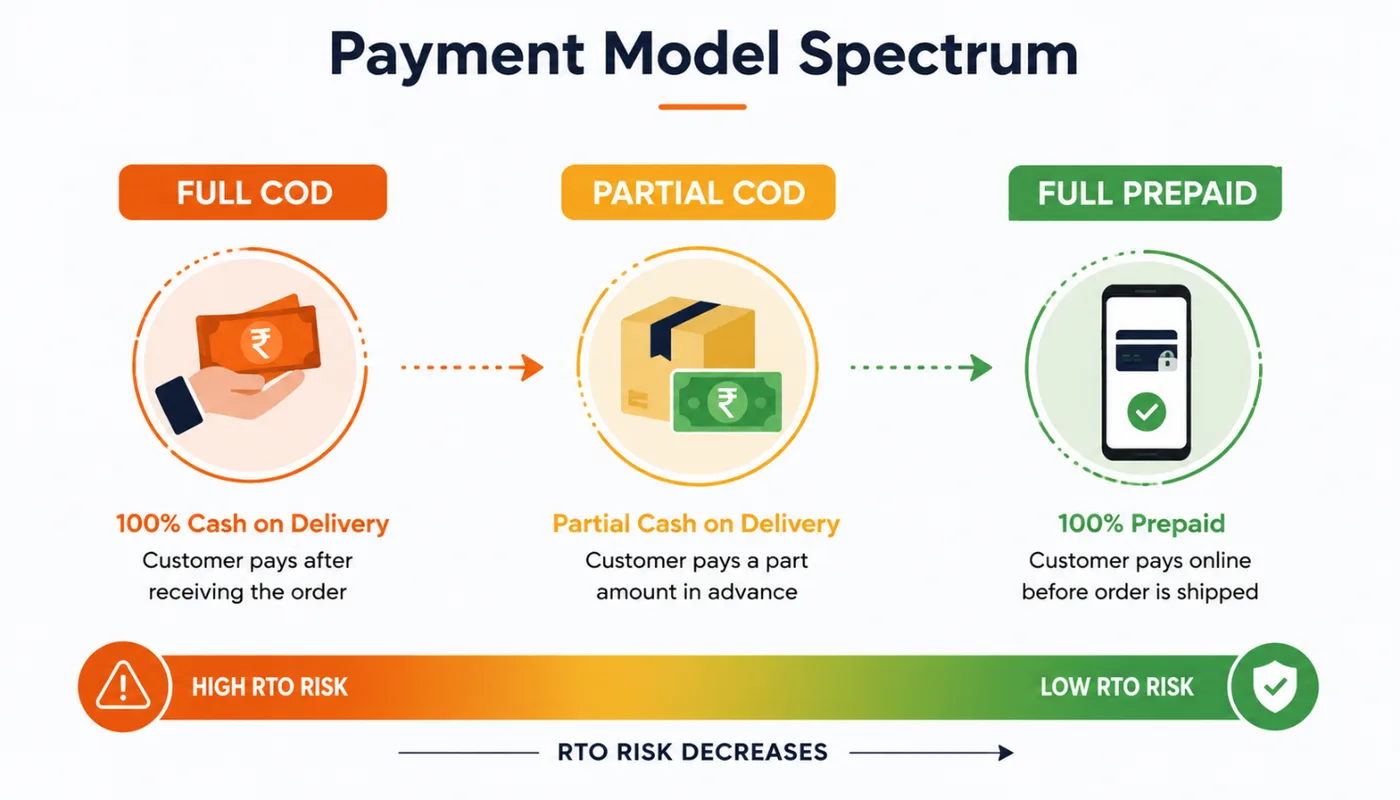
It works because it captures the same behavioural shift that makes prepaid effective — the buyer has committed something — while still keeping the trust barrier low enough that hesitant buyers don’t abandon the cart entirely. Sellers using this well typically see RTO sit somewhere between full-COD and full-prepaid numbers, without sacrificing as much order volume as going fully prepaid would.
Not every courier or checkout platform supports this natively, so it’s worth confirming availability before assuming you can turn it on.
How to decide — by city, category and order value
Rather than picking one method for your entire store, it helps to think in simple if-this-then-that terms:
- Metro buyer (Mumbai, Bangalore, Delhi NCR, Chennai, Noida) + high order value + repeat customer → push prepaid, with a modest discount to nudge them
- Tier 2/3 buyer + new brand + impulse category like fashion, accessories or home décor → keep COD available, but consider partial COD to soften the RTO risk
- High-RTO category regardless of city — electronics, customised products, high-end apparel → lean prepaid or partial COD, since refusal risk is simply too costly here
- First-time buyer on any platform → offer COD, but add an OTP or call confirmation step for higher-value orders before dispatch
How to reduce COD losses without removing COD
You don’t have to choose between keeping customers happy and protecting your margin. A few tactics work well together:
- Frame the discount as “Pay online and save” instead of a COD penalty — same economics, very different psychology for the buyer
- Add a small, transparent COD convenience fee at checkout, reflecting the real cost of the service
- Confirm high-value or first-time COD orders with an OTP or a quick call before dispatch — a low-cost tactic any small seller can run, no enterprise AI tools required
- Restrict COD selectively for pincodes or repeat customers with a history of high RTO
- Send a simple post-delivery nudge — “next time, pay online and save” — once a buyer has already received and trusted a COD order
- Route COD orders through whichever courier partner has the best delivery-success record for that specific pincode, instead of one default courier for everything
A real example: what changing the mix actually looked like
A small fashion D2C brand shipping out of Delhi NCR was running close to 80% COD, mostly because that’s how they’d set up their store from day one. RTO was hovering around 24%, and with remittance taking close to 10 days on average, cash flow was constantly tight — reordering stock meant waiting on money that hadn’t come in yet.
They didn’t remove COD. They introduced a small “pay online and save 5%” prompt at checkout, and switched to partial COD (₹99 upfront) for orders above ₹1,500. Within two months, prepaid share climbed to around 35% of total orders, and overall RTO dropped from 24% to about 14%, since the remaining COD orders were now either lower-value or had that small upfront commitment attached.
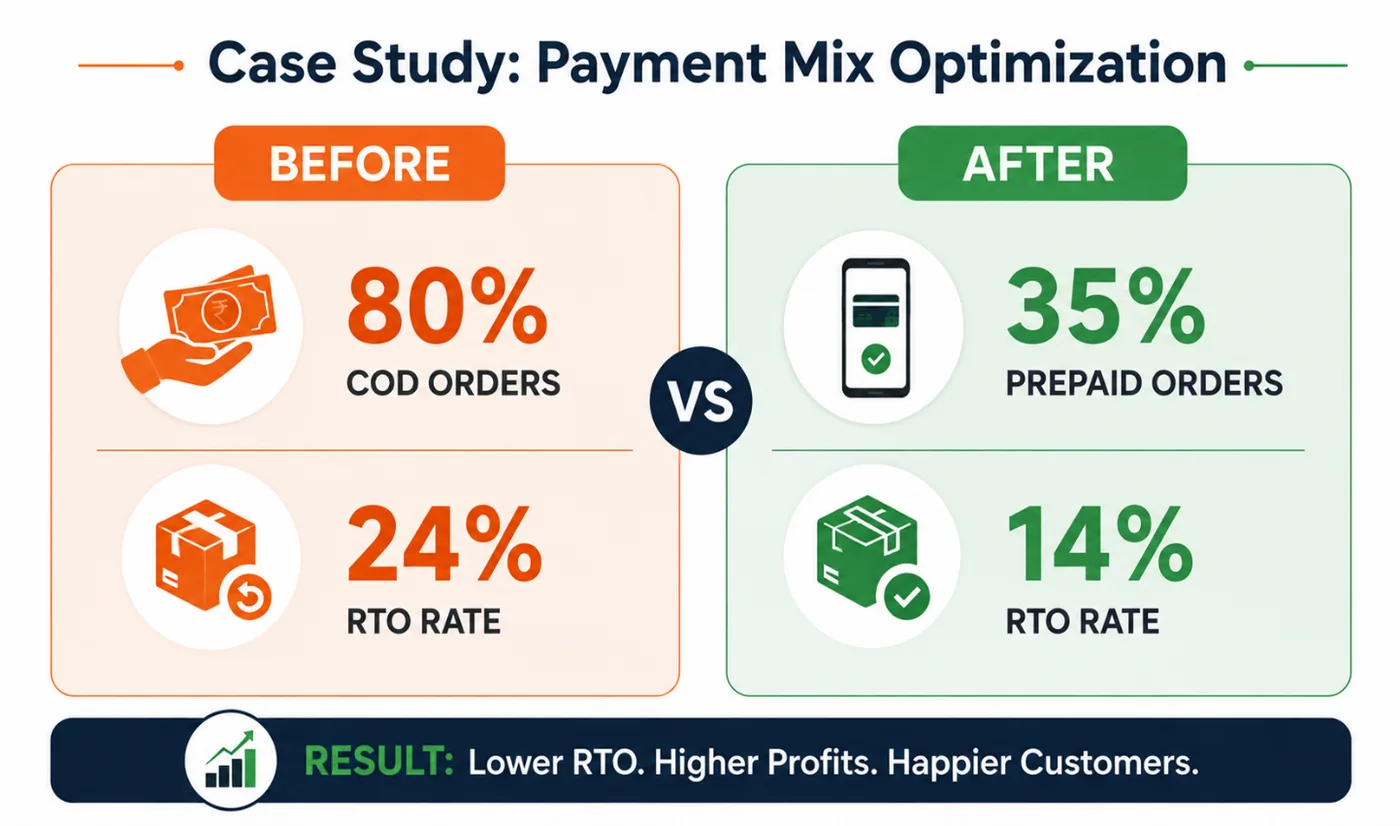
Nothing changed about their products or their marketing. The order mix simply got smarter.
Quick scorecard: should this order be COD or prepaid?
Use this the next time you’re deciding whether to nudge a specific order or buyer segment toward prepaid.
| Factor | Leans COD | Leans Prepaid / Partial COD |
|---|---|---|
| Order value | Low to mid AOV, low risk if refused | High AOV — RTO exposure gets expensive |
| Buyer location | Tier 2/3, rural pincode | Metro / Tier 1 city with UPI habit |
| Category RTO history | Low historical RTO for this category | Electronics, apparel, customised — historically high RTO |
| Buyer type | First-time buyer, needs trust | Repeat buyer who already trusts your brand |
| Courier COD limit | Order value within courier’s COD cap | Order value exceeds courier’s COD ceiling |
Frequently asked questions
What percentage of orders in India are still COD?
COD continues to account for a significant majority of e-commerce orders in India overall, though the exact share varies a lot by category and city tier — metro, high-AOV categories skew far more prepaid than Tier 2/3, impulse-buy categories.
What is a good COD-to-prepaid ratio for a small seller?
There’s no single universal number, but many sellers aim to bring prepaid share up over time through incentives rather than forcing it. A meaningful shift — even moving from 80% COD to 60-65% COD — can noticeably improve RTO and cash flow without hurting conversions much.
Can I remove COD completely from my store?
You can, but it usually costs you conversions, especially among first-time buyers and Tier 2/3 customers who haven’t built trust with your brand yet. Most sellers get better results by optimising COD — through discounts, partial COD, and verification — rather than removing it outright.
What is partial COD and does it actually reduce RTO?
Partial COD means collecting a small token payment upfront and the rest on delivery. Because the buyer has made a financial commitment, refusal rates tend to drop compared to full COD, landing somewhere between full-COD and full-prepaid RTO numbers for most sellers who use it.
Do all couriers support COD for every order value?
No — most couriers cap COD collection at a maximum order value, and this cap varies by courier. It’s worth checking this specifically rather than assuming every order qualifies.
How can I reduce RTO on COD orders without losing sales?
A combination usually works best: OTP or call confirmation for high-value orders, restricting COD selectively on high-RTO pincodes, offering a modest prepaid discount, and routing shipments through the courier partner with the best delivery-success record for that area.
The bottom line
This was never really a COD vs prepaid decision — it’s a matching problem. The right payment method depends on the city your buyer is in, the category you’re selling, the order value, and whether they’ve bought from you before. Sellers who treat it that way, instead of picking one method for the whole store, tend to keep more of what they earn without sacrificing the orders COD brings in.
Want to compare courier partners by COD limits, RTO performance and remittance speed? Check live options on Courier Uncle — free sign-up.
Ship smarter with Courier Uncle
Compare live rates across multiple couriers on your actual routes — sign-up is free, no volume commitment.
Compare rates free →